
WA growers will put controlled-atmosphere technology through its paces this harvest, as part of research into chemical-free alternatives for stored-grain insect control
By Rebecca Jennings
Nitrogen to protect stored grain is not a new concept. The potential to control atmosphere to prevent insects has been known for more than 30 years. However, new and more affordable technology is positioning it as a viable protection option.
Research by Murdoch University,funded by the GRDC through the PlantBiosecurity Cooperative Research Centre(CRC), is taking high-nitrogen (lowoxygen) atmosphere trials out of the laboratory and into the field to assess theimpact on on-farm grain-storage pests.
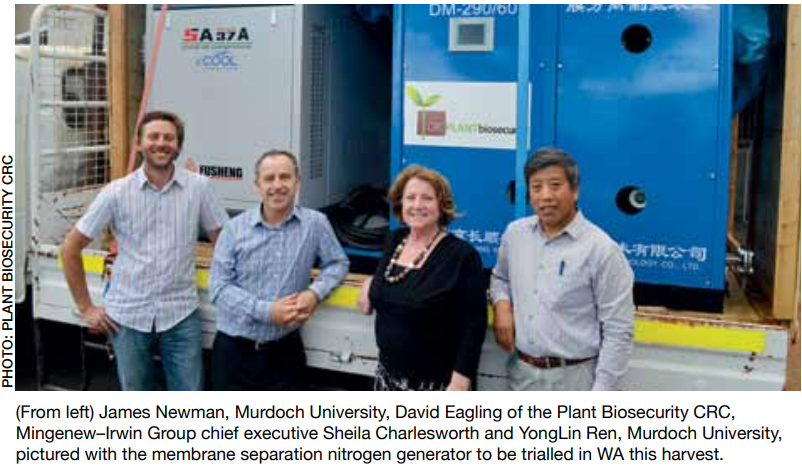
This controlled-atmosphere approach offers growers a nonchemical alternative to phosphine to control pests in grain storage. Nitrogen generators reduce the levels of oxygen in storage structures and most insects cannot exist for long without oxygen. The Plant Biosecurity CRC project takes membrane-based gas separation technology, commonly used in industrial applications such as mining, and applies it to grain storage.
Murdoch University post-harvest biosecurity researcher Professor YongLin Ren, who leads the project team, says that in initial laboratory evaluation, nitrogen controlled all adult and immature stages of Trogoderma variabile (warehouse beetle) and phosphin eresistant and susceptible strains of Tribolium castaneum (red flour beetle), Rhyzopertha dominica (lesser grain borer) and Sitophilus granaries (grain weevil).
In the trials, nitrogen was maintained between 97 and 99 per cent forthree weeks for wheat, barley, oats, lupins and canola stored at 25°C. Professor Ren says an advantage of the membrane-separation system is that integrity of grain is preserved:
“There was no change of moisture, protein, oil, starch or colour after this treatment in any of the grains tested.”
Professor Ren is now working with the Mingenew–Irwin Group in Western Australia to field test low-oxygen environments in grain storage using the membrane-separation generator – a first for the Australian grains industry. This will see the technology applied to canola and chickpeas to ensure nitrogen has no effect on these crops’ market qualities such as oil content and colour.
Advantages
Nitrogen application, particularly using membrane separation, offers integrated technology to reduce postharvest biosecurity threats, such as managing phosphine resistance, insects and grain quality control.However, Murdoch University’s laboratory business and industry liaison manager James Newman says growers do require adequate infrastructure to maintain nitrogen levels for rapid insect control. “You need a well-sealed structure to achieve and maintain a nitrogen level of about 98 percent,” he says.
Control of insects drops off sharply when nitrogen levels fall to 96 percent or below – at that level it can take up to 70 days to control adult grain borers. Nitrogen technology offers freedom from residue and no environmental impact. The development of lower priced units is reducing cost barriers to on-farm uptake of nitrogen technology. “Based on some early sums, we believe the price per tonne for a nitrogen treatment would generally be less than $1,” Mr Newman says. The nitrogen generator was displayed at the Mingenew–Irwin Group’s spring field day in August – attended by about 300 WA and interstate growers – where it received positive feedback. “This generator is ideal in capacity for on-farm storage and would cost between $50,000 and $60,000,” Mr Newman says.
“Growers were enthusiastic about the prospect of a co-owned unit purchased among a group of growers storing grain on-farm. “ This would enable them to invest in the technology without the initial significant capital cost, given that the nitrogen generator would only be required for a few days on each farm per year.” He says the membrane gas separation units are relatively maintenance free and the membrane modules have a life of about 20 years. “I think the idea of using nitrogen for storing grain on-farm will gain momentum over the next few years among growers who can see the economic benefits of storing grain on-farm and selling into the market when it suits them, knowing that the product they offer is high-quality, clean and ‘green’ grain, with no chemical residues.”