By Gio Braidotti
Replacing oxygen in grain storage silos with nitrogen has proven an effective way to remove insects at all stages of their life cycle, leaving stored grain – be it wheat or canola – preserved, residue-free and subject to no withholding periods.
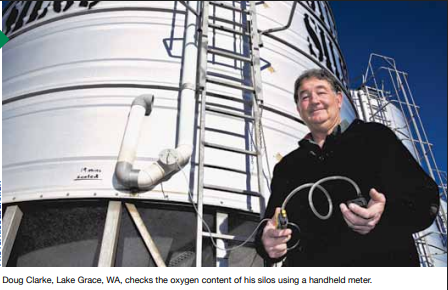
Nitrogen is also the preferred storage option, says Western Australia grower Doug Clarke, who is the earliest adopter of the technology in its on-farm form.
Mr Clarke made the switch five years ago on his Lake Grace property, and has made his silos available to Murdoch University researchers led by stored-grain expert Professor YongLin Ren, with support from the GRDC.
Mr Clarke has hosted visitors over the years, including overseas buyers, and says he has learnt the extent to which insecticide-free grain is preferred by buyers.
While he says the system is performing well, he is committed to continuous improvement.
However, one challenge is that there is currently no price signal favouring residue-free grain to compensate for the investment and the extra work associated with nitrogen-based storage.
In relation to the technology itself, Mr Clarke has no issue with existing oxygen-purging systems. He says the nitrogen generator needed to purify nitrogen from the atmosphere and pump it into a silo is a machine developed by the oil industry, which is widely available.
“At a rate of 30 cubic metres an hour, it costs about $5 worth of diesel to purge a silo of oxygen all the way down to 0.05 per cent total content,” he says. “Best of all, insects never acquire resistance.”
Another challenge relates to infrastructure: silos leaking.
“The standards for sealed silos are too low for nitrogen storage of grain,” Mr Clarke explains. “The accepted level on the seals for a silo is the loss of half an inch (12.7 millimetres) of water pressure in three minutes.”
The oxygen in the silo needs to be purged long enough to kill all insects. Mr Clarke has identified a relationship between eradication time (for all stages in an insect’s life cycle) under nitrogen and grain temperature.
The eradication time is as low as one week at high temperatures, at 20ºC it blows out to three weeks, and below that temperature he says it does not work.
It is these circumstances that have created resistance to insecticides and an interest in the latest sealing technology.
“What I am saying is that the better the seal, the better control you have under any fumigant. We need to be looking to the latest sealing technology, including polymers and 3D printers,” he says. “The area that now needs improving is the silo manufacturing.”
GRDC Research Code NPB00013
More information: Doug Clarke,
dclarke4@bigpond.com; Professor YongLin
Ren, y.ren@murdoch.edu.au;
www.grdc.com.au/NPB00004