Objectives – (Question or information gap to answer)
Can Diatomaceous Earth (DE) dust be applied in sheds using leaf blowers and achieve adequate surface coverage?
Background
As a structural treatment for empty storages, DE controls storage pests that may not have been removed with physical cleaning methods. This ensures the storage is insect free prior to being filled.
DE as a structural treatment is traditionally applied in sheds as a slurry mixed with water. Slurry application is not preferred by growers for reasons including:
- Requires preparation and mixing.
- Application is slow.
- Difficult to get even coverage on all surfaces.
- The slurry prematurely wears out water pumps.
- Leaves the shed walls and roof looking messy.
With recent trials (Development Activity 2024-3) finding leaf blowers can distribute DE very well in large flat bottom silos, the possibility of achieving adequate coverage of DE dust in grain sheds was raised. The traditionally used ‘Blow-Vac’ air-compressor powered venturi, cannot distribute dust more than a few meters, but large leaf blowers were found to be capable of propelling dust over 13 meters high in a flat bottom silo.
With large leaf blowers proven capable of distributing DE dust to significant distances, testing the application possibilities using leaf blowers in grain sheds was identified as a potential solution. If DE dust could be applied in sheds with a leaf blower instead of slurry, the practice could be adopted by more growers who have traditionally avoided the downsides of slurry application.
Development Activity Methodology
Previous testing (Development Activity 2024-3) found the best application tool was a petrol powered leaf blower fitted with an outlet-mounted venturi to draw in the DE dust and distribute via the air stream from the blower.
For this trial, the Stihl BG56 petrol leaf blower was visually compared to the Makita 18Vx2 DUB362Z battery-powered leaf blower. Manufacturer stated performance of both were similar with the Makita airflow specification at 800m3/hr and 194km/h compared to the Stihl’s 700m3/hr and 255km/h.
A side-by-side comparison of the performance of both tools found no visual difference in their ability to project dust via the venturi, so for convenience, the battery powered Makita was used for the trial.
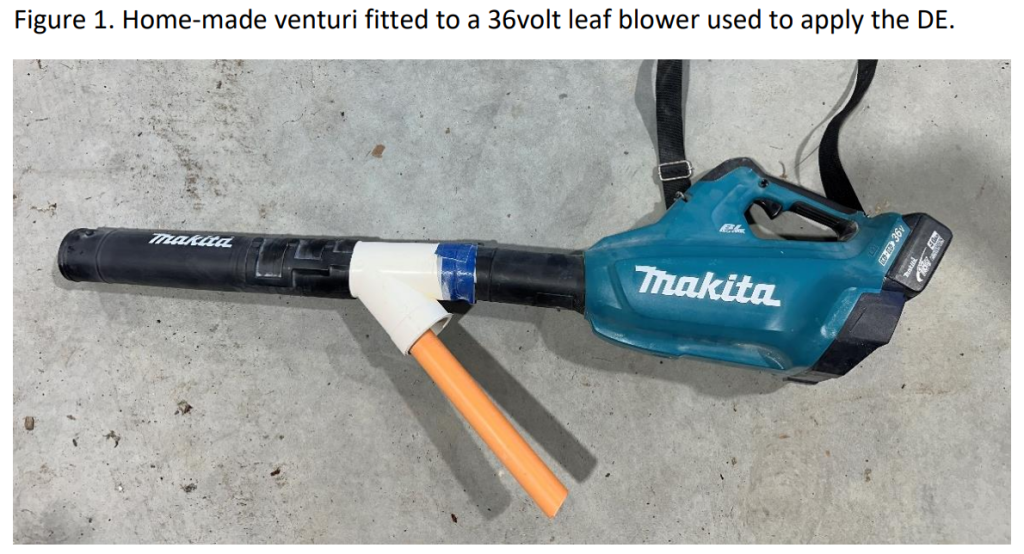
The blower was fitted with a home-made venturi made from a 75mm PVC ‘Y’ fitting and a 32mm pipe on the suction side of the ‘Y’ fitting, via a reducer fitting. The suction pipe had a 45 degree angle cut on the end that was inserted into the ‘Y’ fitting. See Figure 1.
Figure 1. Home-made venturi fitted to a 36volt leaf blower used to apply the DE.
The same distribution testing method utilised in previous testing (Development Activity 2024-3) was also used for this trial.
Collection trays were positioned throughout the shed, mounted to collect the DE dust in a number of positions including:
- Dust settled on the floor,
- Against the walls, and
- On roof purlins and trusses.
The use of trays, while not representative of what sticks to a vertical or inverted surface of the shed, is characteristic of the areas that collect grain dust (floor, wall and roof purlins, trusses). Because these are areas grain storage insect pests may feed and breed, they are also locations where DE dust application as a structural treatment is desirable.
The trays were numbered, weighed empty, placed inside second trays (to avoid contamination if placed on existing dust in the shed) and weighed one hour after application to allow for settling post distribution.
Tray weights were measured using Digitech digital scales with a resolution of 0.01g.
Trial One
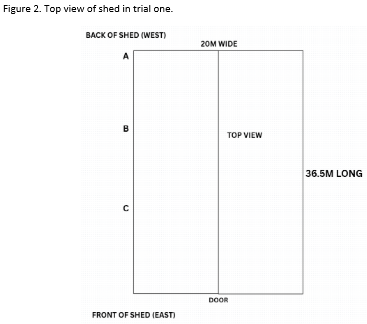
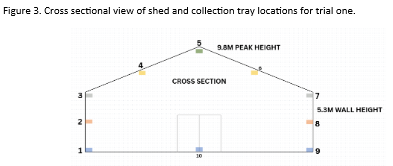
The first trial was conducted in a 3000t capacity shed measuring 20m wide, 35.5m long, 5.3m wall height and 9.8m peak height. The shed was enclosed on all sides with double sliding doors on the east end.
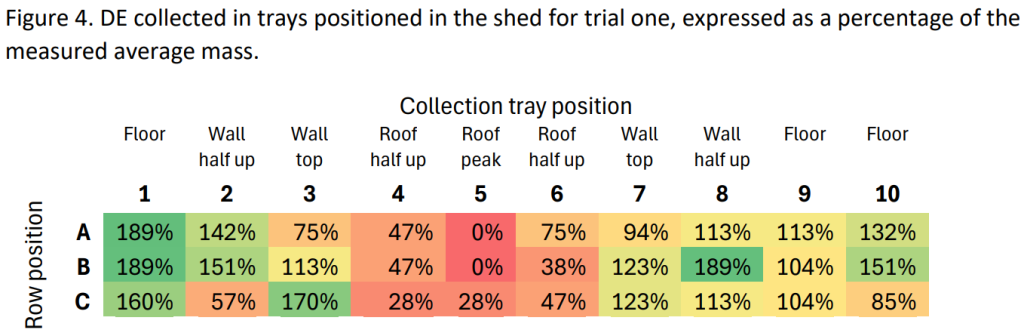
Collection trays were placed in three rows (cross sections positions A, B and C) and 10 positions (1 and 9 on the wall at ground level, 2 and 8 on the walls half way up, 3 and 7 on the wall 700mm below the roof, 4 and 6 half way between the wall and the peak 800mm below the roof, 5 was 800mm below the roof peak, 10 was on the floor directly below the peak. See Figures 2 and 3 for shed dimensions and location of collection trays.
According to the label, the recommended application rate for DE is 2 grams per square meter of internal surface area, which, for this trial equated to a total of 4.5kg.
The application method employed was as follows:
- Measured out the required 4.5kg and divided equally into 3 small buckets, then placed in the shed at the back corner, one third of the way and two thirds of the way down the shed. This helped during application to know how much product was to be applied by ensuring each bucket was emptied in the third of the shed area before moving to the next bucket and third of shed area.
- Starting in the back corner of the shed, (wearing goggles and dust mask) the blower was pointed up at the top of the walls and roof while walking up and back across the shed at roughly 3m spacings, while applying the dust.
- The sliding doors were open during application, which provided a small amount of air movement with wind swirling into the shed. The doors were closed to leave a 1m opening for the hour following application while the dust settled.
Weather on the day was sunny, 15 degrees Celsius, 19km/hr south easterly wind.
Trial One Results
DE distribution was reasonably consistent on the shed floor and walls but was measured at very low levels in the roof space.
During the application, it was visually evident that dust was not reaching the peak of the roof and was only just reaching the roof height halfway between the walls and peak.
Results shown in Figure 4 illustrate some variation between each row of trays (A, B and C) indicating the expected variability due to manual application and wind swirling in the shed.
The learnings from trial one:
- A small amount of wind swirling in the shed visually appeared to aid dust suspension and carry.
- The dust did not reach into the peak of the roof.
- It was noticeably warmer near the peak of the roof when setting up and retrieving collection trays. This difference in air temperature may have restricted the blower ability to propel the dust high into the shed as cooler air from ground level may not have displaced the warmer air above.
- Optimally, a larger shed, tested in the early morning before the roof heats up may improve the results. Additional openings could increase swirling from wind and improve circulation in the shed.
Trial Two and Three
Both trial two and three were conducted in identical, 6000t capacity sheds measuring 27m wide, 71.5m long, 7.5m wall height and 12.7m peak height.
The shed was enclosed on all sides with double sliding doors in both ends.
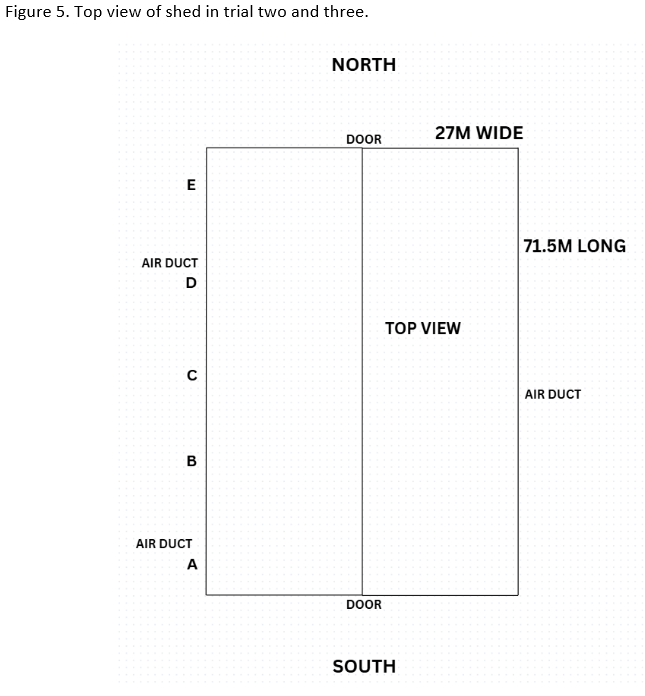
Three holes for air ducts positioned low on the side walls were open to the outside at the time of the trials. Some wind was observed entering and exiting the shed via these ducts as well as a gap between the walls and roof during the trials.
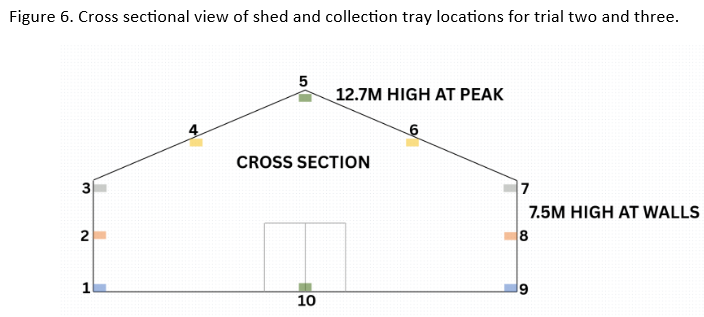
Collection trays were placed in five rows (cross sections A, B, C, D and E) and 10 positions (1 and 9 on the wall at ground level, 2 and 8 on the walls half way up, 3 and 7 on the wall 1m below the roof, 4 and 6 half way between the wall and the peak 800mm below the roof, 5 was 1.5m below the roof peak, 10 was on the floor directly below the peak. See Figure 5 and 6 for shed dimensions and location of collection trays.
For trials two and three, each shed received 11.6 kg, applied at the recommended rate of 2 grams per square meter.
The application method used mirrored that of trial one, with the identified refinements.
When the 11.6kg of DE was measured out into buckets and placed at even intervals along the shed, the two buckets at either end of the shed were allocated more DE than the other buckets to account for covering the end wall.
This meant that while traversing the shed during application, each bucket full of DE was emptied within the bays it was allocated to, aiding distribution uniformity.
Weather at the time of application was sunny, 14 degrees Celsius, 15km/hr south westerly wind.
Air temperature was measured inside the shed just prior to application and found to be 23 degrees Celsius near the floor and 28 degrees Celsius at tray 5 near the roof peak.
Starting in the north west corner of the shed, (wearing goggles and dust mask) the blower was pointed up at the top of the walls and roof while walking up and back across the shed at roughly 3.25m spacings, while applying the dust.
Both end doors were open approximately 1 m during trial two; however, observed dust movement indicated excessive air circulation in the shed. The north end door was subsequently closed and the application resumed, with significantly less air swirling, allowing the dust to float evenly to each side wall and roof.
Trial Two Results
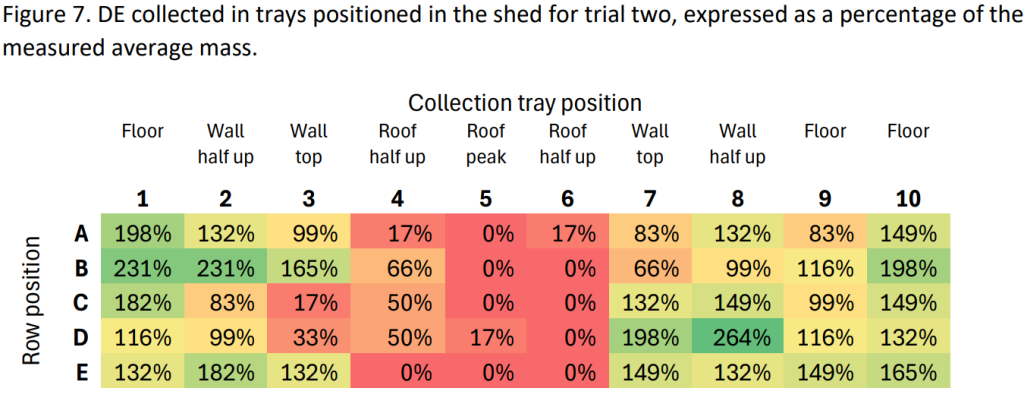
Results measured for trial two delivered lower uniformity than trial one, with very little dust reaching the roof. A contributing factor could be that the roof was an additional 2.9m higher.
Distribution between each row of trays was reasonably consistent but highlighted the benefit of having five rows of trays to average and smooth the inconsistencies in measured deposition associated with manual application and wind movement.
The learnings from trial two:
- Excessive wind swirling in the shed transferred dust making it impossible to distribute it uniformly on all walls. While some air movement appears to assist uniform deposition, a balance is required.
- Very little to no dust was propelled beyond the 7.5m height of the shed walls. The air velocity from the leaf blower appeared inadequate for this height.
- A theory of walking across the shed applying the dust, then backtracking the same path with the leaf blower to propel the suspended dust further did not appear visually to improve distribution uniformity.
Trial Three Results
Trial three was a direct replication of trial two with some refinement in application technique.
- The shed door at the northern end was closed for the duration of application, with the southern end door open approximately 1m.
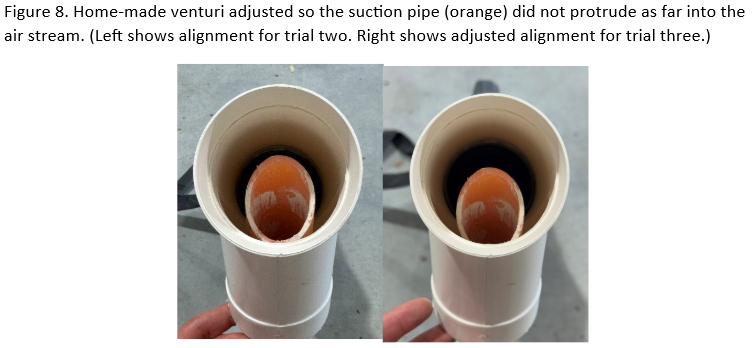
- The home-made venturi was adjusted slightly so the suction pipe did not protrude as far into the air stream. See Figure 8. This reduced the rate of suction but visually improved the distance the dust was propelled.
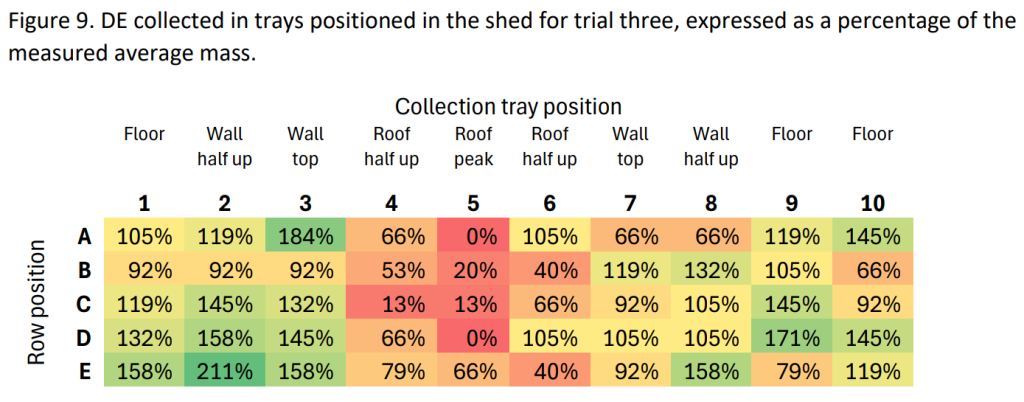
Results from trial three were measured to be significantly better after application refinements. Notably, collection trays placed halfway up the roof (position 4 and 6) measured almost three times the quantity of those in trial two.
Dust collected in the trays at the roof peak (position 5) were highly variable, ranging from a promising 66% of the average at the Southern end to zero at two other positions. See Figure 9.
The results indicate it is possible to distribute DE dust to this roof height but requires careful application to avoid missing sections, as happened in this third trial.
The learnings from trial three:
- Adjusting the suction pipe on the home-made venturi for more airflow and less suction, increases the time taken to apply the same quantity of dust but delivered an improved distribution to the higher surfaces in the shed.
- Diligence in application is required to avoid missing sections of the shed.
Outcome and Recommendations
Applying DE as a dust into sheds is possible, although it can be expected that less product will reach the higher parts of the roof than is likely to settle on the walls and floor.
Manual application of a product will always include a level of inconsistency, so care should be taken to apply the dust as uniformly as possible to the shed walls and roof to avoid missing sections.
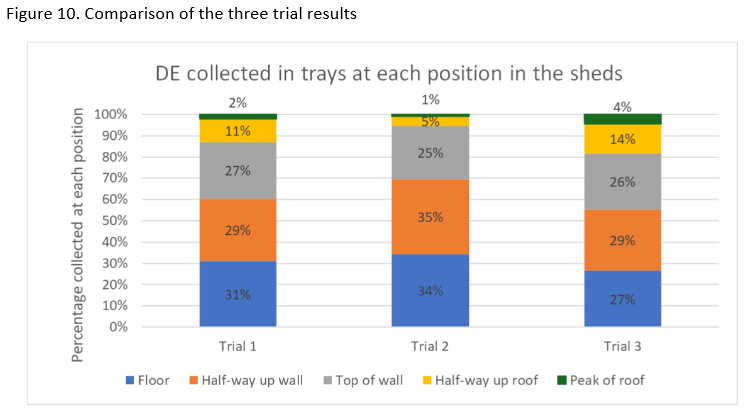
Figure 10 compares the results of the three trials showing the percentage of DE dust that was collected at each area of the sheds.
The sheds used in trials two and three were double the capacity and 2.9m higher than in trial one. Given the results from trial three were found to be more uniform than in trial one, venturi adjustments and application technique have a greater impact on distribution than shed height, even in sheds up to 12.7 m peak height.
Figure 10 demonstrates that the proportion of DE dust reaching the roof’s peak is considerably lower than the amounts deposited on the walls and floor. Nevertheless, it is notable that coverage extends to all areas within the shed, meeting the intended objective.
Trial photos
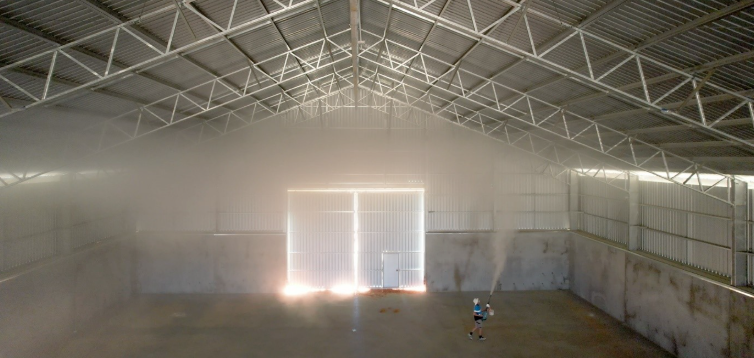
Application process, pointing the leaf blower at the roof while traversing the shed.
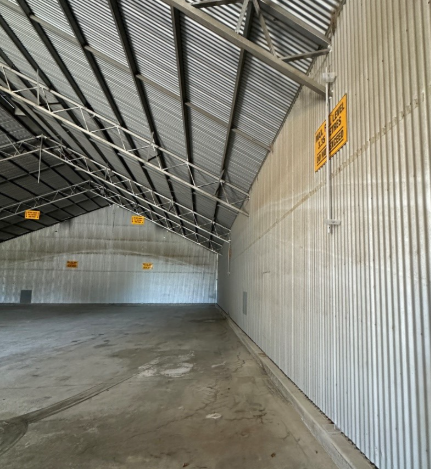
Some of the tray positions used to collect DE dust for measurement, (floor beside the wall, halfway up the wall and at the top of the wall).
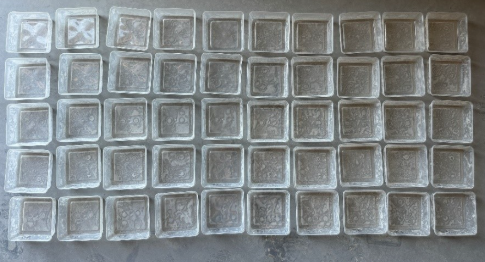
Trays collected after weighing for visual assessment of dust quantity in each.
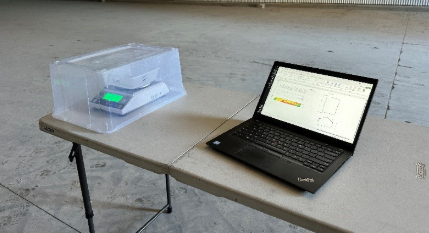
Digital scales with a resolution to 0.01g and shield used to weigh trays.
Download Full PDF Report here: