
Economics of Grain Storage
Aeration running costs
Grain Storage Specialists Chris Warrick and Ben White step through an example to calculate aeration running costs.

Grain Storage Specialists Chris Warrick and Ben White step through an example to calculate aeration running costs.
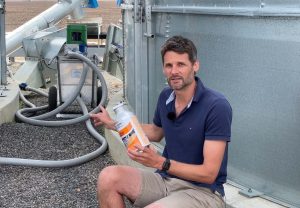
GRDC Grain storage specialist Chris Warrick explains how long to leave phosphine in large grain silos. What does ‘surface only application’ mean on the phosphine label?
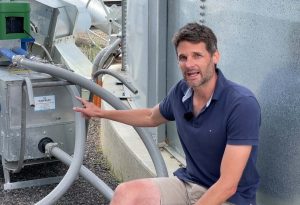
GRDC Grain storage specialist Chris Warrick explains a key feature of fumigation recirculation systems in grain silos.
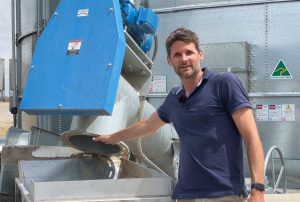
GRDC Grain storage specialist Chris Warrick demonstrates why a pressure test before every fumigation is worth while. Silos may be pressure tested on delivery or installation but ensuring they are actually sealed before fumigation can save time and ensure a successful result.
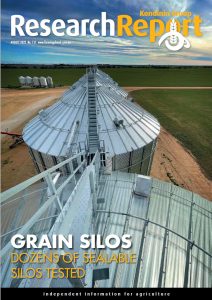
Download the Kondinin Group Research Report on Grain Silos 2022

With care, bags and bunkers can provide a practical solution to the harvest logistics challenge.
High-quality sealed silos offer top-of-the-range storage, but the boom in demand for on-farm storage means growers are also exploring cheaper options to expand capacity.
Bags and bunkers have become a popular, more affordable choice, but growers need to be on their toes to avoid costly failures with these temporary storage solutions.

Take a sneak peek at some of GRDC’s storage extension team’s favourite systems.
The grain storage extension team regularly meets growers and industry participants on-farm to run workshops and provide specialist advice. Examples of well-laid-out facilities, smart features, ideas and innovations are highlighted here to help inspire other growers who are investing in grain storage infrastructure.

Key message
– Ground-level fumigation systems are safer for users, but phosphine can be explosive, so precautions are needed to ensure a safe and effective fumigation.
Phosphine fumigation can now be completed using ground-level application systems, which are much safer as the user does not need to climb to the top of the silo. But some key features and precautions are needed for successful and safe fumigation:
– recirculation;
– space for liberation;
– condensation trap; and
– pressure relief for power outage.

Key points
– Gas-tight sealable silos should meet the Australian Standard AS2628-2010 for sealing but should only be sealed during a fumigation
– Open sealed silos after fumigation to protect seals and grain quality and, importantly, to prevent excess fumigant absorption
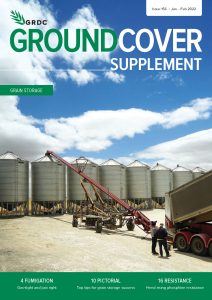
Download the GRDC Ground Cover Supplement on Grain Storage from Jan-Feb 2022.