Skip to content
Insect Control

Phosphine curbs cowpea weevils in stored pulses

Key points
– Cowpea weevils – or bruchids – are an important insect pest in stored pulse crops in tropical and subtropical Australia
They can be effectively controlled using label rates of phosphine fumigant in sealed silos over a minimum period of seven days
– No major differences in tolerance to phosphine were identified in 15 populations collected from multiple Queensland locations

Read More »
Insect Control

Probing phosphine resistance in rusty grain beetle

Key points
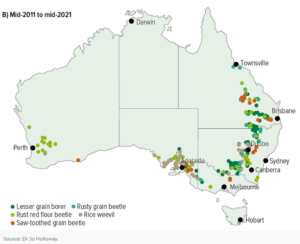
– Strong resistance to phosphine in rusty grain beetle has increased substantially since the first resistant population was discovered in 2007
– The rusty grain beetle is mobile and resistant populations are present across the full spectrum of the grain supply chain
– Area-wide integrated pest and resistance management has the potential to suppress this problematic species indefinitely

Read More »
Insect Control

Users must heed rising phosphine resistance

Key points
– Strong resistance to phosphine in stored grain insects has both increased and spread over the past decade, with more detections in eastern Australia than Western Australia
– Misuse of phosphine, particularly in unsealed storages, appears to be the main reason for the development of strong resistance

Read More »
Insect Control

Phosphine venting and delivery limits require more research

Key points
– Testing phosphine residue in trucks at receival sites is required for operator safety and label compliance
– Sampling and testing methods require further research and development to avoid penalising those doing the right thing
– Using a phosphine meter on farm is the surest way to avoid truckloads being rejected

Read More »
Grain Storage Facilities

Getting the most out of ground-level fumigation

Key message
– Ground-level fumigation systems are safer for users, but phosphine can be explosive, so precautions are needed to ensure a safe and effective fumigation.
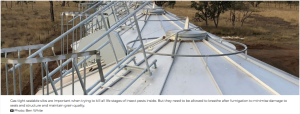
Phosphine fumigation can now be completed using ground-level application systems, which are much safer as the user does not need to climb to the top of the silo. But some key features and precautions are needed for successful and safe fumigation:

– recirculation;
– space for liberation;
– condensation trap; and
– pressure relief for power outage.

Read More »
Insect Control

Successful fumigation: GAS-TIGHT AND JUST RIGHT

Key points
– Successful pest control in storages depends on combining regular grain monitoring, good hygiene, aeration cooling and correct fumigation practices
– Fumigation results rely on a gas-tight sealable storage to achieve the required gas concentrations and exposure times (C x T) to kill all insect pest life stages
– In larger silos (150 to 2000 tonnes) recirculating gases using a small fan during the fumigation ensures rapid, uniform distribution of phosphine gas

Read More »
Grain Aeration

GroundCover Supplement – Grain Storage (Issue 156, Jan–Feb 2022)

Explore the latest grain storage research, fumigation practices, aeration systems, and on-farm storage innovations featured in the GroundCover Supplement: Grain Storage (Issue 156, Jan–Feb 2022). This edition highlights practical strategies helping Australian growers protect grain quality, manage phosphine resistance, improve storage efficiency, and maximise long-term profitability.

Read More »