Skip to content
Grain Storage Facilities

Making the most of ageing silos

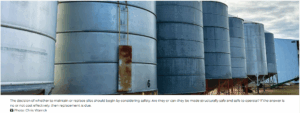
As silos age, growers face a crucial decision: repair, retrofit, or replace. The first step is always safety. Grain Storage Specialist Chris Warrick advises that growers begin by checking whether the silo is structurally sound. Cracked or tilted bases, rust on critical joints, or weakened bolts and sheets can all compromise safety and increase the risk of collapse. Faulty hatches, ladders, and access points also need to be addressed to protect workers.

Read More »
Grain Storage Facilities

Correct storage edging towards the norm

Australian growers are steadily lifting the standard of on-farm grain storage. In the past 15 years, average capacity has almost tripled – from about 850 tonnes in 2009 to more than 2450 tonnes in 2024. This growth reflects the importance of storage as part of the farming business model: capturing market premiums, smoothing harvest logistics, and safeguarding grain quality.

Read More »
Information Hub

Fumigant resistance: small victories in an unrelenting battle

As insect resistance to phosphine continues to climb across both on-farm and bulk storage, growers face a constant challenge: how to slow resistance while protecting grain quality and market access. Recent GRDC-supported resistance monitoring shows a slight dip in strong phosphine resistance this year, but the overall national trend remains upward, with about 30 per cent of pests now showing strong resistance—well above the 10–15 per cent level considered manageable.

Read More »
Grain Quality

Changing storage practices may lead to an improved falling number

New research supported by GRDC and led by Agriculture Victoria scientists Dr Cassandra Walker and Dr Pankaj Maharjan suggests that on-farm storage practices may play a role in lifting the falling number of wheat after harvest. Their work showed that wheat samples with a moderate falling number (200–300 seconds) could increase by up to 50 seconds during 24 weeks of storage, often moving them above the key 300-second benchmark. High-range samples above 400 seconds continued to improve until plateauing at around 36 weeks, while low-range samples showed little change.

Read More »
Grain Storage Facilities

Kondinin Group Sealable Storage Report

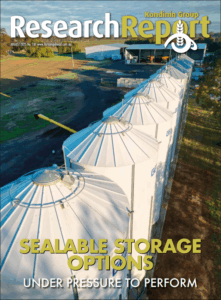
The latest Kondinin Group sealable storage report is here! Building on the 2022 review of grain silos, this updated report provides fresh insights, performance comparisons, and practical guidance for growers considering on-farm storage options.

The new findings highlight key changes in silo performance, sealing effectiveness, and best-practice recommendations to help growers make informed decisions when investing in grain storage infrastructure.

Read More »
Information Hub

Phosphine Best Management Practices: Disinfesting stored commodities

Phosphine remains the most widely used fumigant in Australia’s grain industry due to its effectiveness, low cost, and residue-free status. However, increasing resistance among key insect pests highlights the need for strict adherence to best practice guidelines.

This comprehensive manual outlines:
1. Proper application methods across different storage types (silos, bunkers, sheds)
2. Critical factors such as gas concentration, exposure time, temperature, and moisture
3. Equipment for monitoring gas levels and ensuring safe fumigant handling
4. Strategies to delay and manage resistance, including use of sulfuryl fluoride and integrated pest management

Compiled by leading experts including Dr Manoj Nayak, Dr Joanne Holloway, Chris Warrick, and Patrick Wilson, this document is a valuable resource for growers, storage operators, and advisors working to maintain grain quality and market access.

Read More »
Grain Hygiene & Structural Treatments

Diatomaceous Earth (DE) Application

Evaluating Application Methods for Diatomaceous Earth in Grain Storages
Originally published as Development Activity 2024-3 | Project Code: PRB2011-001SAX

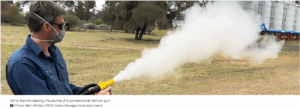
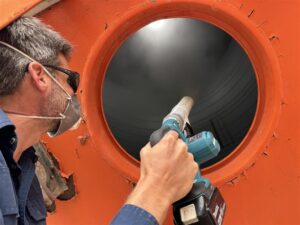
Diatomaceous Earth (DE) is an important structural treatment used to control storage pests in empty silos. This development activity compared dry application methods for distributing DE in both cone-bottom and flat-bottom silos, aiming to identify approaches that achieve the most uniform coverage across all silo surfaces.

Key Findings:

The 18v battery blower and petrol-powered leaf blower, used with a venturi attachment, provided more uniform distribution of DE than the benchmark compressed-air BloVac gun.

In the flat-bottom silo, ground-level application via access door resulted in consistent DE coverage at all levels – offering a safe and effective method.

Venturi-assisted delivery created a finer, more stable dust cloud, improving reach to upper silo sections.

Longer application time increased air circulation and dust suspension, enhancing coverage.

Recommendations:

Use battery or petrol-powered blowers with a homemade venturi (ideally a “Y” fitting with a half-diameter suction pipe) for optimal distribution.

Apply DE from ground level while moving the blower nozzle regularly to target all areas.

Maintain dust circulation during and after application to reach higher wall areas.

Future Work:

Further trials should refine blower application techniques and explore the use of DE in grain sheds.

Download the full report: Diatomaceous Earth Application – DA 2024-3 (PDF)

Read More »
Grain Quality

Seeds need cool, dry conditions, no matter the variety

As investment in on-farm storage grows, new research shows why it is critical to maintain wheat seed in cool, dry conditions

Agriculture Victoria research scientist Dr Cassandra Walker was not surprised that her study into the impact of storage conditions found that wheat seed viability declined at higher temperatures.

But what did strike her was the significant role that moisture plays, and in particular the difference in viability between grain moisture levels of 11 and 14 per cent.

“We studied two moisture levels – the upper end of what is considered safe at 11 and 14 per cent – and clearly there’s a tipping point between them where grain viability is lost,” she says. “So moisture content has a big part to play, as well as temperature, in germination potential. You can preserve grain viability for longer with lower moisture levels.”

Read More »
Grain Aeration

Monitoring Grain Temperature

During this video, Chris Warrick and Alex Conway discuss ‘Monitoring grain temperature’ and explore the various methods available and the factors to consider when deciding on a system that’s best suited to your business.

Read More »