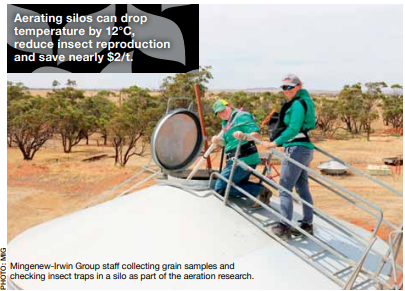
Independent engineers and grain storage specialists have demonstrated that the sun’s energy can be harnessed to keep silos that are located away from a mains power supply cool and insect-free. Tests in a 75-tonne silo at Wyalkatchem, Western Australia, 200 kilometres northeast of Perth, by independent engineers. Ben White and Josh Giumelli and grain storage specialists Chris Warrick and Peter Botta showed it is possible to build an energy-efficient, solarpowered. aeration-cooling system.
The GRDC-supported project, led by Ben White, found aeration-cooling systems in 75t silos typically use 0.37-kilowatt, 240-volt motor-driven radial fans, which deliver about 200 litres of air per second at 200 pascal static head backpressure. This equates to a fan efficiency of about 1850 watt-seconds/m3. For maximum efficiency, Mr White and his team selected a backward inclined, curved blade centrifugal motorised impeller fan with an electronically commutated (EC) brushless direct-current motor. With this combination, specific fan power at comparable flow rates and backpressure was reduced to 560 watt-seconds/m3, a 330 per cent efficiency improvement on standard fan motors usually suggested for grain aeration cooling. The use of an EC motor prevented the application of an off-the-shelf aeration control system, so the research team customised a solution to meet its requirements. “The controller uses two internal thermocouple temperature sensors embedded in the grain and selects the hotter of the two. This temperature is then compared with the external ambient temperature,” Mr White says. “If the external ambient temperature is lower than the grain temperature, and the ambient relative humidity is below 80 per cent, the controller engages the fan at the nominated operation speed.
Alternatively, the fan can be set to run continuously, except when ambient relative humidity exceeds 80 per cent.” To accommodate the fan, a manhole access door was modified to extend into the silo, allowing the fan to be mounted inside with a large open-area free-flowing plenum attached. To collect sunlight energy, four 260W multi crystalline solar panels were chosen to provide a total array size of 6m2.
For superior longevity at higher depth of discharge ratios, the team selected Absorbent Glass Mat (AGM) batteries.
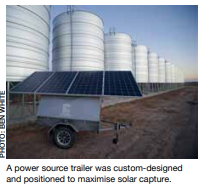
Mr White says these batteries offer charging rates five times higher than flooded deep-cycle cells and are more resilient to deep-cycle depth of discharging. To manage panel energy and prevent overcharging the batteries, a 48V power management system including a 3000W pure sine-wave inverter was chosen. This was wired through a 240V power distribution board to provide a 240V outlet to run the aeration fan and controllers. For testing, the components were mounted into and on top of a trailer with custom-built battery and solarpanel storage for transport, internal electrical inverter and panel mounting. On site, the panels were mounted at 30 degrees to the horizontal.
In the silo, airflow was distributed via the customised scroll surrounding the fan impeller and a plenum designed to minimise backpressure and maximise open area to about 0.3m2. The silo was filled with ScopeA barley and airflow rates across a range of fan speeds and power draws were measured when the silo was half-full and full. Airflow performance was found to be acceptable, with results showing the system could effectively cool barley to 15ºC. While the results for the prototype are encouraging, Mr White says further refinement of the components would be needed to suit specific silo applications. He also encouraged the use of a licensed electrician to ensure correct fitting of electrical components.
GRDC Research Code BMW00001
More information: Ben White, 0407 941 923,
ben@storedgrain.com.au