
There are reasons behind various grain fumigation strategies. Understanding the considerations will reduce the chance of grain storage issues arising.
The need for the first fumigation will largely depend on how well hygiene and structural treatments of grain handling and harvesting equipment, and storages, have been carried out prior to harvest.
Sealing storage to fumigate straight after harvest can run the risk of trapping harvest heat and moisture, which can lead to condensation forming in the silo headspace. This results in mouldy grain in the top of the silo.
Cooling
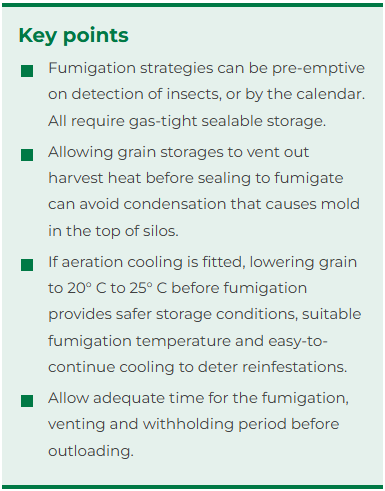
Ideally, grain is cooled with aeration cooling fans as soon as it is put into storage.
If aeration cooling is not installed, leaving storages open to vent the harvest heat out of the headspace can be beneficial.
As grain temperature is cooled, however, insect life cycles slow down, making them more difficult to kill with phosphine. Phosphine is not effective on insects when grain temperature is below 15° C.
One strategy is to use aeration cooling to cool grain to 20° C to 25° C. At those temperatures, conditions are significantly safer to seal for fumigation. Aeration cooling can then continue to be used to reduce the temperature below 15° C to discourage reinfestation.
Storing under fumigation
An approach we see occasionally is growers putting grain under fumigation and leaving it sealed up for long periods if there is no sale date or use for the grain in the short term. The risk with this approach is that if there is an issue – condensation, failed fumigation and insect survival – it is not being detected if the grain is not monitored while under fumigation.
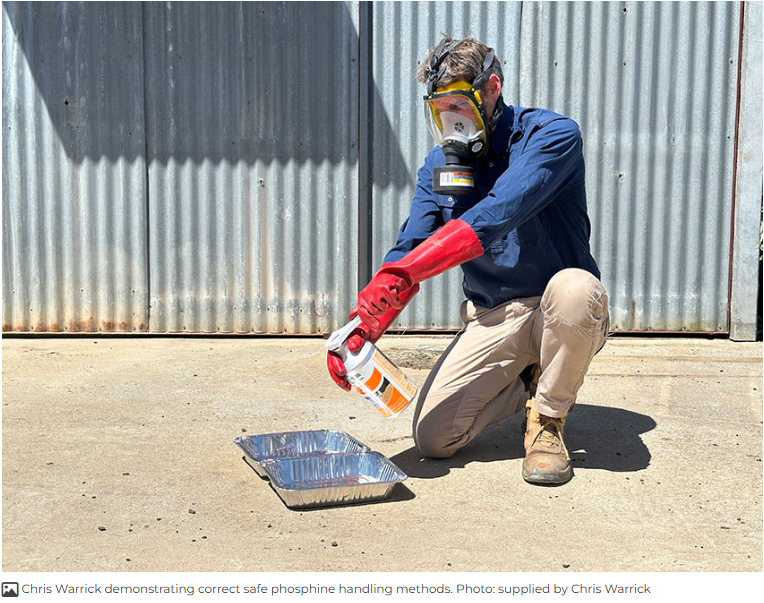
There is also another issue to be considered. Under fumigation, grain can absorb some of the phosphine. After extended periods under fumigation, the time required for the grain to desorb during venting will also be extended. In some instances, that time can be extended for weeks if the grain was sealed under fumigation for months.
As phosphine is a knockdown fumigation (not a protectant with residual effect), one strategy is to only fumigate once insects are detected, providing the grain temperature is not below 15° C.
Monitoring
Monitoring for insects requires probe traps in the grain and/or sieving a grain sample. Ideally, and if safe to do so, probe traps and samples should use grain from the top of silos where temperatures are warmer and insect breeding is typically more prevalent.
If silos have been built without safe ladders, or an elevated work platform is not available, then monitoring becomes limited to samples collected from the bottom of the silo. This leaves unresolved the question of whether there are insects at the top. In this case, some growers choose to fumigate grain regularly as they cannot be confident about whether there are insects causing damage.
Fumigation timing
There is also another issue to be considered. Under fumigation, grain can absorb some of the phosphine. After extended periods under fumigation, the time required for the grain to desorb during venting will also be extended. In some instances, that time can be extended for weeks if the grain was sealed under fumigation for months.
As phosphine is a knockdown fumigation (not a protectant with residual effect), one strategy is to only fumigate once insects are detected, providing the grain temperature is not below 15° C.
Monitoring
Monitoring for insects requires probe traps in the grain and/or sieving a grain sample. Ideally, and if safe to do so, probe traps and samples should use grain from the top of silos where temperatures are warmer and insect breeding is typically more prevalent.
If silos have been built without safe ladders, or an elevated work platform is not available, then monitoring becomes limited to samples collected from the bottom of the silo. This leaves unresolved the question of whether there are insects at the top. In this case, some growers choose to fumigate grain regularly as they cannot be confident about whether there are insects causing damage.
Fumigation timing
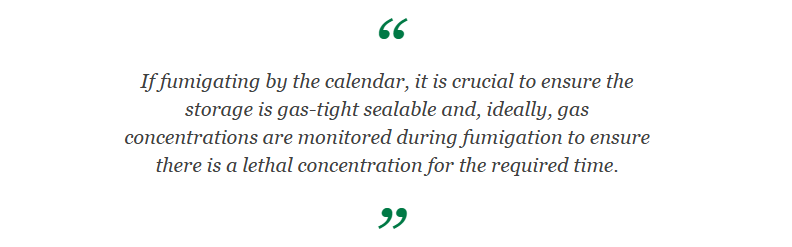
A simple half-life pressure test determines if a storage is gas-tight sealable, which is a good indication that fumigation will reach and retain a lethal concentration over time.
Fumigations in non-gas-tight storage run the risk of insects (adult, egg, larva, pupa) surviving the fumigation and reinfesting grain. What’s worse is that the insects that survive will be the ones with a tolerance to phosphine. So repeat fumigations by the calendar – if done poorly – selects for resistance, quickly rendering phosphine ineffective.
Leave enough time
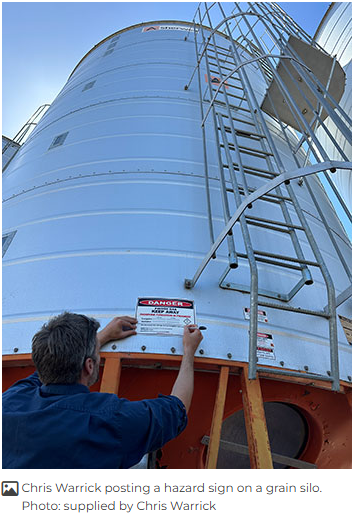
Regardless of the fumigation timing strategy, it’s always important to leave enough time for the required exposure period (7, 10 or 20 days) and adequate venting and withholding periods.
According to the current phosphine label, venting with aeration cooling fans will take at least one day. Without aeration fans, it will take at least 5 days. Experience is showing us that these vent times are a minimum and there are plenty of examples where longer vent times are required – for example, in grain bags where passive venting has taken 35 days.
The reliable way to ensure grain is adequately vented before outloading (and to meet delivery requirements) is to use a safety or low-level clearance phosphine meter.
Research is being done on venting and measurement protocols to conform with Safe Work Australia changes that come into effect from December 2026. With these changes, the time-weighted average worker exposure limit will be reduced to 0.05 ppm and the peak limit will be reduced to 0.15 ppm. The GRDC GrowNotes on grain storage contains how-to guides and video links on managing grain storage including aeration cooling, pressure testing silo and fumigation processes.
More information: Stored Grain or call your nearest grain storage specialist on 1800 WEEVIL
Resources: GRDC GrowNotes: Grain Storage (Jul 2024)
This article was written as part of the Grain Storage Extension Project. This GRDC investment provides information and training for growers to use best practice for on-farm grain storage.