When making a decision about installing on-farm grain storage facilities, consider the costs and benefits carefully. Successful on-farm storage depends on a range of factors including storage and handling equipment, the capital costs and management used to maintain grain quality and control insects and mould. Long-term on-farm grain storage in Australia has, until recently, been limited to seed and coarse grains stored as stock feed. These have been stored in small bins and insect control has not been a high priority. Investment in small, expensive-per-tonne silos for on-farm storage is a cost-effective option for stockfeed grains when offset against the high cost of transporting grain for stockfeed to the farm on a regular basis. But current deregulation of grain markets is now creating a need for more long-term on-farm storage of grain which will eventually enter commercial trade. The objective is to exploit market opportunities and to apply grain management procedures to maximise crop income. On-farm storage of commercial grain requires larger, cheaper-per-tonne stores and improved grain management, including pest control, compared with grain stored for stock feed.
In Brief
- Successful and economic on-farm storage will depend on a range of factors including the type of storage and handling equipment selected, the costs involved and management to control insect pests and mould.
- Currently, bolted steel silos, bunkers, sheds and shipping containers are available for on-farm grain storage.
- Well managed on-farm storage facilities can maximise grain marketing opportunities and complement existing commercial bulk handling operations.
Quality control

The key element of a successful commercial on-farm grain storage system is safekeeping grain against insect and mould damage. This is particularly important in Australia
where wheat and barley are taken into storage at high grain temperatures and where long, hot summers and short, mild winters favour insect development. During recent years, growers who invested significant capital in on-farm storage have turned away from their investment because of difficulties in maintaining grain from insect attack and moulding.
The best way to protect grain against mould development is to dry it to moisture levels below which mould spores can develop before it is transferred into storage.
If the grain moisture content exceeds certain critical values, the spores of specific fungal species will start developing. These critical moisture values often occur at increments as small as 0.5 per cent and therefore accurate and dependable moisture measurement is important. Moulds develop at a fast rate if grain temperature is high but the key factor is grain moisture content. Safe moisture content for wheat is about 13% or less, with little variation between kernels and through the grain bulk. This is particularly important when the crop is harvested early and artificially dried.
To achieve successful on-farm grain storage, build efficient, user-friendly storage facilities equipped with insect control technology.
Silo storage equipment
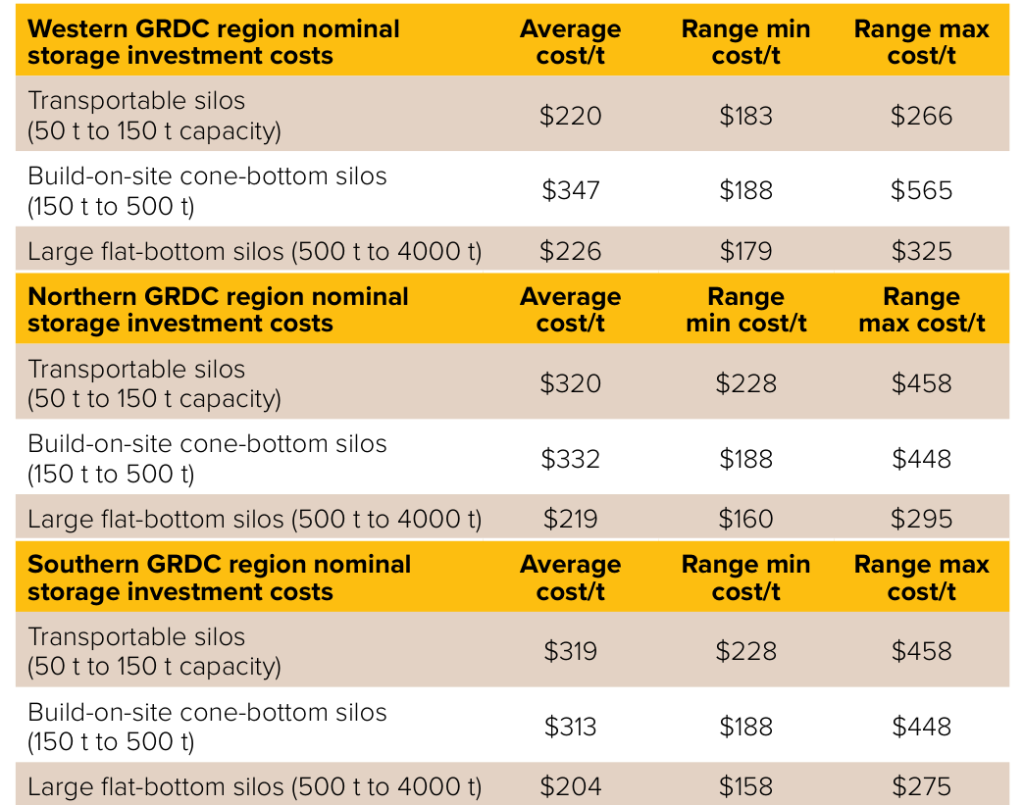
During the past 10 years, on-farm grain storage capacity in Australia is estimated to have risen by 700 kilotonnes, mostly in the form of bolted steel silos. It represents 700 1000t silo bins at a capital cost from $21 million to $42m. In other grain producing countries where the grain trade has been deregulated in recent years, such as Argentina and Canada, bolted steel silos are also increasingly being used for on-farm storage of commercial grain.
In the United States and Europe, most grain has traditionally been stored on-farm and particularly during the past 20 years, bolted steel silos have been commonly used for this purpose. Worldwide, grain traders and millers also use bolted steel silos. Bolted steel silos are popular as they are cheap and effective, and suit current grain storage systems and practices. Globally, a significant amount of capital has been invested in the current grain storage infrastructure. Therefore, unless significantly cheaper and improved grain storage technology becomes widely available, bolted steel bins are likely to be manufactured and sold for at least another 20–50 years.
Many of these bins will probably still be in operation in 50–80 years. Most bolted steel silos are made of corrugated steel sheets but various designs are available. The international market for bolted steel silos is supplied mainly by companies in the US, with some South American and European companies also active.
Costs and benefits
The capital cost of a bolted steel silo is about $30 per tonne plus Goods and Services Tax, depending on the size of the silo. The cost of delivery, construction, concrete works and electrical works must be added to this, as well as the cost of grain handling machinery. Currently, bolted steel silos in general are not designed to serve as efficient fumigation chambers. Maintaining insect-free grain stores relies almost exclusively on aeration. But under Australian climatic conditions aeration alone will not control stored grain insects and a method of chemical control may be required to satisfy market demands. Bolted steel silos of limited height can be filled using a fixed or a mobile grain auger, or a pneumatic grain conveyor but higher silos need a bucket elevator.
As a rule, silos are emptied with a grain auger, usually permanently installed in the silo. Silos with flat floors often have a sweep auger to work the last grain in the bin to the centre from where the outloading auger can pick it up. But some grain always remains on a flat floor and invariably becomes insect infested if not cleared away, therefore infesting any new grain loaded into the silo. A conical concrete or metal floor offers improved insect control. A conical concrete floor is only slightly more expensive than a flat concrete floor and offers larger silo capacity. But groundwater must be drained away from under the floor to a sump from where it can be pumped out to avoid water seepage into the bin.
Bunkers and shed storage
Other grain store types currently available for on-farm use include bunkers and sheds. Included in this category are steel mesh structures lined with plastic sheeting. Large bunkers (20–30kt) provide cost-effective grain stores but the cost per tonne of storage capacity increases significantly as the bunker size decreases. The need to replace the plastic sheeting every few years to maintain a weatherproof seal significantly increases the capital cost of the structure over time. Bunkers consisting of plastic sheeting can be beneficial fumigation enclosures for grain safekeeping. The main advantage of bunkers is most of the capital outlay is spread over its period of use. Small sheds, which can be sealed sufficiently gastight for successful fumigation with phosphine are also available for on-farm grain storage.
These sheds are based on hybrid technology with bolted corrugated steel silos. Shipping containers, which can be bought or rented, can also be used. A 6.15-metre container can accommodate about 27t of wheat and can be fitted with a polyethylene liner to improve its gas tightness for fumigation. The purchase price is about $2150 plus GST and delivery, which brings the capital cost of the container to about $80/t. Renting a shipping container for 3–6 months is about $30 per week plus GST or about $29/t for the full period. Grain-handling equipment for on-farm inloading and outloading from small bunkers, sheds and shipping containers currently rely on mobile augers, which can be difficult to use.
Grain storage costs
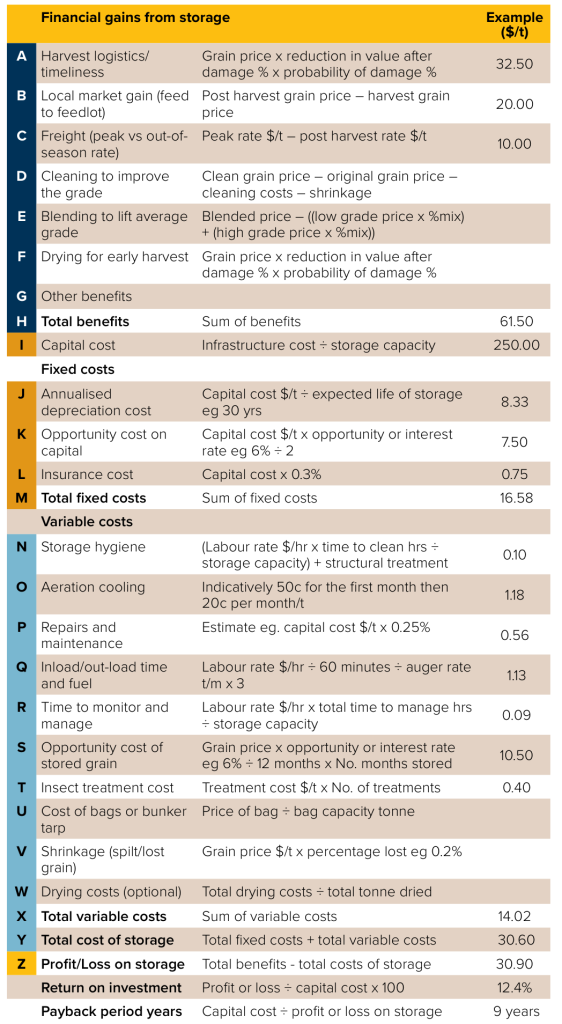
When making a decision about installing on-farm grain storage facilities, consider the following costs:
- The cost of fixed assets, for example, the capital costs of the storage structure, grain handling equipment and grain safekeeping equipment. Included in this are delivery, construction and installation costs to provide a fully operational facility.
- The cost of owning the facility, which includes maintenance, depreciation on capital equipment, insurance and opportunity cost of interest on money invested in the facility.
- The opportunity costs, which include interest on the value of the grain in storage and insurance.
- Grain management and husbandry costs, including storage losses, drying costs, electricity costs for grain handling, pest control costs and labour
Competitive advantage
Worldwide, increasing numbers of affluent grain consumers are becoming more discerning and this is reflected in more stringent grain quality specifications. This drives a need for greater segregation and improved blending management of grain types to meet contract specifications. On-farm storage of commercial grain is not always in competition with centralised grain storage.
Indeed it offers bulk handlers additional opportunity to make up grain consignments which meet customer requirements more closely without risking investment in infrastructure to segregate grain lots of finer quality differences. Demand from different markets for cheaper staples is also driving a need for lower-cost grain storage and handling methods such as large bulk bunkers and sheds. The combination of a well-managed on-farm storage system for segregation complementing the central storage system could provide improved efficiencies and marketing advantages.
For more information contact Jan Viljoen, CSIRO Stored Grain Research Laboratory, by email on jan.viljoen@ ento.csiro.au, phone (02) 6246 4206
On-farm storage increases marketing options

Installing a 5000-tonne on-farm grain storage facility has saved time and money for South Australian continuous croppers Brett and Gavin Roberts, Balaklava. According to Brett, on-farm storage has improved harvest timeliness, eliminated warehousing costs and increased their grain marketing flexibility and options. After warehousing feed barley at $10.50 per tonne plus freight costs of $7/t, the Roberts decided to look at the alternative of on-farm grain storage.
During 1999, they installed four 1700-cubic metre Cyclone Butler steel silos at a cost of $70/t. This included power connection at the site and a $25,000, 25-metre power take-off Farmking auger for grain filling. Each silo is fitted with a 120-millimetre outloading auger which has improved operation speed and a sweeper to clear any remaining grain from the silo’s flat floor. A conical floor was considered but it was not cost-effective.
A final manual sweep of the silo is carried out to ensure no grain remains before the silo is filled again. The site was chosen because it had three-phase power, which reduced running costs. The facility is also close to a bitumen all-weather road, which is vital for easy truck access.
Insect control
The silos are unsealed, which Brett admits probably should have been carried out. But there have only been minor insect outbreaks in the grain peak, where it is hot. The outbreaks have been controlled using phosphine, although Brett said this method was inefficient in an unsealed silo. For the 2001–2002 harvest he plans to apply a layer of inert dust called Dryacide on top of the grain peak which will seal the grain from insect attack. The silos have an in-built aeration system to manage moisture levels and cool the grain. They aim to cool the grain to less than 15 degrees Celsius, ideally 10oC, to reduce pest build-up.
Quality assurance
The Roberts family is involved in a pilot Graincare programme which will ensure its storage facility becomes accredited. Brett said the accreditation was easy and involved documenting hygiene and storage practices they have already performed. Although he does not believe Graincare accreditation will provide price premiums, they may become preferred suppliers for specific markets.
Benefits
The Roberts can store about half of their total harvest tonnage. They then sell depending on the market and advice from the Australian Barley Board. Brett believes on-farm storage has given them increased marketing options and more flexibility, for example, they have already forward sold next season’s barley, which ABB will pay them to store. He said on-farm storage complemented centralised bulk storage facilities and was perfect for domestic grain sales. He said grain could be kept separately, quality control was improved and if there were any problems with the grain at harvest, particularly with tighter receival standards, it could be stored and cleaned later. Harvest convenience and timeliness was an advantage as there was no waiting in silo lines and grain could be unloaded at any time of the day.
This article appeared in the November 2001 edition of the Kondinin Group’s monthly magazine Farming Ahead. The Kondinin Group holds the copyright on the article but CSIRO has the unlimited right to reproduce the text royalty free in its own publications. Reproduction of this text in whole or part by any other publication or for any other purpose is not permitted without permission of the Farming Ahead editor.For more information contact the Kondinin Group on (08) 9478 3343.