Storedgrain App

Stored Grain App Icon

The GRDC storedgrain app is now available from the Apple App Store or Google Play

Download now from the Apple App Store or Google Play or access your grain storage records on the web portal synchronized to your app A key feature is the ability to record grain Storage Details and Monitoring Records at the storage site regardless of mobile reception or data speed. Simply enter the records you wish to keep and next time you’re back in mobile reception range, records can be synchronised between multiple mobile devices and/or exported to excel. Record storage details such as grain type, variety, grade, quantity, paddock/source, date filled, date emptied and who it was sold to for your own records and quality assurance tracking. Each time a storage is monitored the app allows you to record the date, temperature, moisture content, pests identified, treatment details and any other notes. How to guides and videos on pest identification, silo buying, fumigation, hygiene and structural treatments, aeration cooling and aeration drying are all included in the app. If you still need more information, use the direct links to Ask an expert and have your grain storage questions answered. Click here for help with the storedgrain app

The GRDC have made the strategic decision to close the storedgrain mobile app permanently.

With limited uptake and use of the storedgrain app, it’s not economical for the GRDC to continue investing in its maintenance and development. Production and supply chain traceability has also been identified as a limitation of a standalone grain storage app.

The GRDC’s Grain Storage Extension Team will encourage and support the commercial, crop production software providers to develop grain storage capability into their platforms, so grain in storage can be traced back to the paddock and treatments applied during production.

We trust you support the strategy driving this decision and together we look forward to the opportunities it will provide to streamline and simplify production and storage recording.

Grain Entrapment Demostration

Stored Grain Entrapment video

The rescue unit is the first of its kind in Canada. Previously, units had been rented from the United States for demonstrations. It was designed and manufactured by Prairie Agricultural Machinery Institute in Humboldt.

Demonstration Video

Grain Silos Tested, Research Report by Kondinin Group Farming Ahead 2015

Stored Grain grain research report

Since deregulation, there has been a growing trend to store an increasing amount of grain on farm. But maintaining the quality of grain in storage requires planning, knowledge and the right gear, none more important than the silo itself. Kondinin Group engineer, Ben White, travelled 8,000km across every mainland state to inspect nearly 60 silos on-farm from different manufacturers, taking photographs and undertaking a pressure test according to Australian Standards where applicable.

Carbon Dioxide (CO2)

Stored Grain Co2

Introduction

Carbon dioxide is an alternative insect pest control option to the most commonly used fumigant, phosphine. Driven largely by market request for ‘organic grain’ or ‘clean & green’, carbon dioxide is usually easier to manage in smaller, gas-tight silos less than 300 tonnes.

If using carbon dioxide, it should be referred to as a ‘controlled atmosphere’ treatment and not a fumigation. The process involves replacing oxygen with carbon dioxide to a concentration that is toxic to insects over an extended time.

The gas-tightness of the silo is critical to successfully control the atmosphere inside the silo. Control of all insect pests will not be successful if small air leaks in the silo allow carbon dioxide gas to escape and oxygen to re-enter.

Key requirements for effective control of all insect life stages using carbon dioxide.

• Pressure tested, gas-tight silo (See https://storedgrain.com.au/pressure-testing/)
• The time to undertake the grain treatment which is typically 15 days
• Sufficient supply of food grade carbon dioxide gas
• Equipment to measure carbon dioxide gas concentrations during and following application

Adding carbon dioxide

The most common way to add carbon dioxide to a gas-tight, sealed silo is with pressurised cylinders of liquid, which when released from the bottle changes to a gas. A specifically designed carbon dioxide regulator is required to control the rate that gas is released from the bottle into the silo via a short high pressure tube.

Carbon dioxide is about one and a half times heavier than air and is non-flammable, colourless and odourless. Gas is introduced into the base of the silo and concentration levels are measured at the top with a gas line going to the headspace. The gas-tight, sealed silo will of course need the standard pressure relief valve fitted to sealable silos to allow natural expansion and contraction of the air inside the silo when it’s sealed.

One kilogram of liquid carbon dioxide produces approximately half a cubic metre of gas. As a guide, one 30 kilogram (size G) cylinder of carbon dioxide treats 15 tonnes of storage capacity, plus one extra cylinder. For example, a 60t silo would require five cylinders (15t per cylinder plus one extra).

While carbon dioxide is released into the bottom of the silo, air is forced out through the opened silo top lid or vent. Each cylinder may take about three hours to dispense the 30kg. If it freezes, change to another cylinder while the other one thaws. Have a delivery hose as short as practical, this reduces the amount of freezing in the tube. Extra time may be needed to allow it to thaw.

Using a manifold system allows more than one cylinder to be connected at one time to speed up the application process.

Once the target starting concentration level of 80-90 per cent carbon dioxide is reached at the top of the silo, the gas is turned off and the top lid is sealed shut.

Monitoring during treatment

The minimum required concentration for effective control of all insect species (except Trogoderma spp.) at all life stages is not less than 35 per cent carbon dioxide for 15 days where the temperature is at or above 20 degrees Celsius. Carbon dioxide is less effective at grain temperatures below 20 degrees Celsius so a longer exposure period is required. Lower ambient temperatures will cause the gas cylinders and gas lines to freeze quickly, so application will be slower. When ambient temperature is below 15 degrees Celsius, carbon dioxide application is not recommended.

Check gas concentration levels throughout the treatment using the tube going to the silo headspace and the gas measuring equipment. Carbon dioxide concentration must remain above 35 per cent for the treatment period, so more gas may need to be added depending on the quality of the gas-tight, sealed silo.

If excessive toping up of carbon dioxide is required because the silo is not gas-tight, the treatment will become very expensive and pest control may not be successful.

Safety

Carbon dioxide is classified as an asphyxiant gas to humans and concentrations between 7-10 per cent may cause suffocation. Concentrations even as low as two percent can cause respiratory distress so silos treated with carbon dioxide should never be entered during treatment or until the silo is sufficiently ventilated. Use the silo aeration system to thoroughly vent all the carbon dioxide.

Warning signs, tape and locked access points help prevent accidental exposure from someone entering a silo under treatment.
Ensure all safety instructions and advice is followed.
Gloves are a must when handling carbon dioxide cylinders or pressure tubing during application.

For more information contact your local carbon dioxide supplier such as BOC, or call 1800 WEEVIL to talk to a grain storage specialist.

Grain Storage Mite Pests

Grain Storage Mites

Authors: Dr Manoj Nayak, DAF, Ecosciences Precinct, Dutton Park Brisbane

Introduction

Mites are common pests in grain storages and mostly occur in damp or moist grain, residues, oilseeds and animal feeds. They are not readily seen because they are the size of specks of dust. Mites are not insects (which have six legs) but are related to ticks and spiders and have eight legs.

  • When present in large numbers mites appear as a moving carpet of brown dust on the grain, silos and sheds or on stacks of commodities, sometimes emitting a damp or pungent smell. The mould mite Tyrophagus putrescentiae (Schrank) is the most common grain storage mite.
  • The grain or flour mite, Acarus siro is also widespread and sometimes the ‘straw-itch mite’, Pymotes tritici can cause problems in storages.
  • A predatory (and therefore, beneficial) species Chelyletus malaccensis Oudemans, is also encountered where the above species are present. Generally, 2-3 species are present in an infestation.

Grain Storage Mite Pests
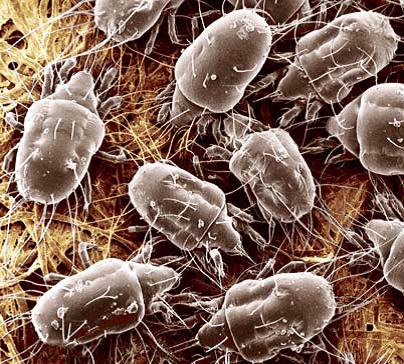
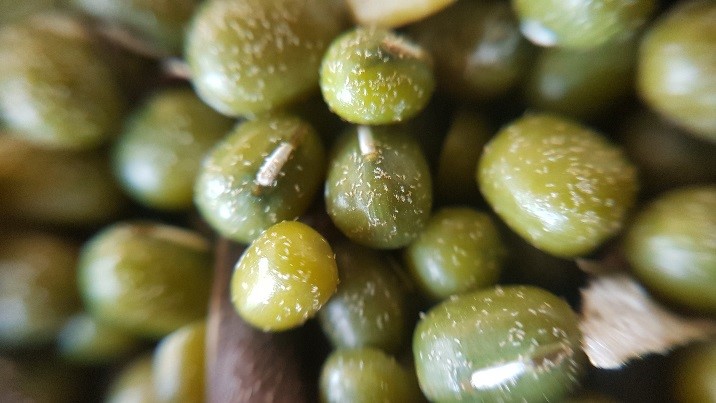
Above Top: Mould mite, or Lemon-scented mite (Tyrophagus putriscentiae). Approx. length: 0.5mm. Above Bottom: Mite infested mungbean.

Acknowledgements: The close-up image has been accessed from Systematic Entomology Laboratory, Agricultural Research Service, United States Department of Agriculture. www.sel.barc.usda.gov/acari/frames/mites.html, (accessed 15/05/2017).  Mungbean image Penny Borger DAF Qld. 2018

Biology

Mites multiply under high humidity conditions (over 65% relative humidity) and upper temperature limit of 35-37 DegC. Under these conditions, the common mould mite completes its life cycle in 8-12 days and a maximum population growth of 500 times per month can occur. Because of their rapid growth in warm, moist conditions, they usually reach peak numbers during late summer.

They are more common in the higher humidity of coastal regions than in drier inland areas. Infestations of mites are generally more conspicuous in commodities with high moisture content and contaminated with mould. Heavy infestation of other stored product pests often creates favorable conditions for mite outbreaks.

Damage

Both the mould and grain mites cause direct damage by eating the germ of the grain and spreading fungi in the commodities. Heavily infested commodity becomes tainted with off-flavours caused by squashed mite bodies when it is moved or processed.

During heavy infestation from the mould mite, the dead and live mites settle as a brownish dust layer on stacks of commodities and floors of stores and emit a lemon-flavoured odour leading to the popular name ‘Lemon-scented mite’. In this situation, they can cause discomfort to workers handling infested grain and packaged commodities. The ‘straw-itch mite’ can cause severe dermatitis and allergic conditions in people handling infested commodities. Infested feedlots are also been reported to have caused feeding problems and allergic conditions in stock. The markets reject heavily infested commodities.

Recommendations for controlling mites

Control starts with hygiene

Strict hygiene practices in and around grain or produce storage and handling areas are essential for control:

  • Remove and destroy unwanted, infested produce by burning or burying.
  • If infested produce is to be kept, fumigate as described below.
  • Clean up and destroy grain dust and grain residues at least weekly.
  • Clean grain storages and handling equipment before handling new uninfested produce.

Insecticide treatment

Methoprene (eg, Rizacon S®, IGR®), is currently registered as a stored grain treatment for insect control and is known to be effective against these mites.

A pyrethrum insecticide product, (eg Pestigas®)

Spinosad (eg Conserve Plus®), can also control these mites.

Commonly used protectant insecticides that are known to be ineffective against these mites are: pyrimiphos-methyl (eg Actellic®), chlorpyrifos-methyl (eg Reldan®) and fenitrothion (numerous trade names).

Manage Temperature and Moisture

Because of their need for warm, moist conditions, mite numbers can be kept low by:

  • reducing temperature below 20 DegC, for example by aeration, or
  • reducing moisture below 55% relative humidity or 12% moisture for cereal grains, for example by drying.

Disinfest with phosphine fumigation

Fumigation with phosphine will kill mites only if it is done in a sealed, gas-tight storage. Dosages lower than recommended on the label often allow mite eggs to survive during the fumigation. Reinfestation due to subsequent hatchings can then occur after the fumigation period is over.

Apply 1.5 tablets per cubic metre and leave the enclosure sealed for 7 days if temperature of the produce is above 25 DegC, or for 10 days at lower temperatures. Air the treated produce before it is handled.

Pest identification problems?

If you are in doubt about the identification of insect or mite pests in stored products, please send live specimens to Dr Manoj Nayak, Postharvest Grain Protection Team, Ecosciences Precinct, 3C West, 41 Boggo Road, Dutton Park, QLD 4102. Please be sure to include your full contact details, and details of any treatment the pests may have had.

Further information

1800WEEVIL

www.storedgrain.com.au

Where stored grain beetles come from (GRDC Ground Cover May 2017)

Stored Grain Sieving insects

Source Link GRDC

Key points

  • Grain is most likely to be infested by beetles from your storage facility
  • Effective hygiene can delay infestation for at least two months
  • Beetles typically fly within a two-kilometre radius to infest another grain storage
  • Some beetles can fly more than 100km to infest grain
  • Flying beetles are spreading insecticide resistance over large areas

Photo of a mini silo fitted with 50 litres of wheat set up near existing farm storage

A mini silo filled with 50 litres of wheat set up near existing farm storage.

PHOTO: Dr Andrew Ridley

Infestation of stored grain can sometimes seem inevitable, but storage pests are reliant on a food source that we control. Too often we provide a friendly environment for these pests by failing to detect and deal promptly with infested grain, or clean out empty silos and equipment.

If we are ever going to reduce our reliance on killing pests once they have infested grain, we need to better understand the insects and how they infest our grain storage in the first place.

The results from research conducted on Australian grain farms by the Queensland Department of Agriculture and Fisheries and the University of Queensland offer some helpful instructions for grain storage best practice.

Harvested grain placed into a silo can become infested from two potential sources. First, there may be a residual pest population hiding in grain handling machinery or silos that will be incorporated into freshly harvested grain. Second, pests can move into the grain of their own accord by flying in from infested silos.

A common misconception is that pests are brought in with the crop at harvest time and this is when infestation starts. It is true that insects such as grasshoppers and lady beetles are harvested along with grain, but these field crop pests die quickly in the dry conditions of stored grain.

The majority of stored grain beetles do not infest standing crops, so this is not likely to be the source of the problem. Only if you are harvesting legumes or maize should you be concerned about gathering up unwanted storage pests with your grain.

When harvesting legumes or maize, keep an eye out for adult beetle exit holes (these are hard to miss) or small white eggs glued to the surface of the seeds in grain samples. Also, use an insect sieve for maize and legumes as you are filling silos during harvest. Get pests identified correctly to see if they are field pests or storage pests. When storage pests are detected during harvest, aerate grain initially over the first two weeks to provide safe uniform grain storage conditions, then seal the silo to fumigate pests. Once pests are killed, return to aeration.

Residual pest populations

Photo of Dr Philip Burril

Dr Philip Burrill of Queensland DAF sieving grain from a mini silo placed 2km from farm storage in Mount McLaren.

PHOTO: Dr Andrew Ridley

Most grain storage beetles are long-lived and can survive on very small amounts of food. Grubs of the red flour beetle (Tribolium castaneum) can survive on the thin layers of grain dust that settles on flat surfaces.

It can be difficult, therefore, to eradicate pests from machinery and storages unless these structures are specifically designed to assist in cleaning. Some silos are made with flat internal surfaces so grain and dust have nothing to cling to. Flat bottom silos with ‘full floor’ aeration are, in contrast, not easy to clean. Removing grain residues in the subfloor area is difficult. Some manufacturers provide a flat bottom silo with channel aeration systems that are simple to clean and just as effective for aeration cooling.

When purchasing new grain storage, take hygiene into account. The silo will be there for a long time and the easier it is to clean the more likely you are to do it.

Grain-handling machinery that contains small amounts of grain can be a source of pests. One header we sampled was hiding more than 1000 lesser grain borers (Rhyzopertha dominica) waiting to be mixed with freshly harvested grain.

Headers, augers, grain dryers and other grain-handling equipment can be cleaned with compressed air and then dusted with a diatomaceous earth product such as Dryacide® to kill any remaining pests.

Likely sources of pests

If you have an existing infestation somewhere at your grain storage facility, your freshly harvested grain will most likely become infested with beetles quickly.

Photo of a beetle trap

One of the beetle traps set one kilometre from grain storage that caught storage pests flying from one farm to another.

PHOTO: Dr Andrew Ridley

We placed wheat in mini silos (50-litre capacity) near farm silos in central Queensland and sieved the grain after two months. We also looked for pests in the storages on each farm. We found that where a farm already had a particular pest species in storage facilities, it usually infested the clean grain in our nearby mini silos quickly.

We also found that the mini silos were unlikely to become infested by pest species that were not already present on the farm. This demonstrated that hygiene, when done well, can delay the onset of infestation by at least two months. For grains harvested in spring, delaying infestation beyond summer can greatly reduce the need to control pests once temperatures drop in winter and pests are less likely to be flying.

Disposal of old and waste grain that tends to be heavily infested will make the greatest impact on the number of pests in your storage facility.

Even small parcels of grain can produce huge numbers of pests. When 100 beetles each of six pest species were introduced into a 27-kilogram box of wheat, more than 1.5 million beetles were produced over the course of a year. Most of these beetles were caught leaving the infestation.

But how far away do you need to dump waste and infested grain? If possible it is always best to bury, burn or spread (less than 10 millimetres deep) infested waste grain.

Grain in mini silos, which were placed two kilometres away from a storage facility was much less likely to be colonised by flying beetles. Therefore, if possible, separate infested grain from grain you wish to sell insect-free by at least two kilometres. This will significantly decrease the risk of infestation from flying storage pests.

Mixed farming operations have particular challenges in terms of insect-free grain storage. Feed mills are difficult to keep pest free because the continuous flow of grain makes sealing silos for fumigation difficult.

The labour involved in cleaning hoppers and augers leads to exposed parcels of grain highly likely to contain storage pests. If I go to a farm looking for storage pests and see a feed mill, the hopper is the first place I look. Storage piles of cotton seed are also a favoured site for the red flour beetle, a common pest of grain in storage.

Mean number of lesser grain borer beetles caught in 15 traps baited with R. dominica pheromone lures

Figure 1 Mean (± standard error) number of lesser grain borer (Rhyzopertha dominica) beetles caught in 15 traps baited with R. dominica pheromone lures located at farm storages (red) and in paddocks at least one kilometre from those storages (orange). Traps were active for seven days at each sampling period.

If feed mills and stored commercial grain are co-located, grain protectants can be used on feed grain to reduce the chance of these grains becoming breeding grounds for storage pests. Always check the chemical label and discuss chemical application with potential buyers prior to applying any grain protectant treatments.

It is easy to wonder how you ended up with infested grain despite doing a thorough job of hygiene. Unfortunately, just as pests are moving from silo to silo within a complex, they are also moving between properties. We showed this in southern Queensland, where we set up traps for flying beetles in paddocks at least 1km from farm storage, typically along fencelines. We caught lesser grain borers and red flour beetles throughout the year (Figure 1).

So what you and your neighbours do to manage stored grain pests will have an impact on everyone.

Resistance moves with beetles

The ability to manage grain storage pests with grain protectant insecticides and the fumigant phosphine is extremely valuable to the Australian industry. Nil tolerance for live pests is the standard for receival, so tools to deal with storage pests are crucial.

One of the big downsides of beetles moving from one grain storage to another is the potential spread of resistance to control tools. Long-term storage of grain that relies on multiple applications of phosphine or over-reliance on one type of grain protectant – or ineffective fumigation due to silos not being sealed correctly – will result in selection for resistant populations that are harder to kill. These difficult-to-control pests then fly off and infest other parcels of grain.

We can measure the relationships of beetles from different farms using genetics. What we found, after sampling farms in the Southern Downs district of Queensland, is that there has been enough movement to make all beetles from an area of more than 4000 square kilometres become part of ‘one big family’.

This means when one person does the wrong thing and allows selection for resistance, these harder-to-kill beetles are moving to other farms. Using this population genetics technique we estimate that some beetles have travelled more than 100km.

The movement of resistance genes is particularly important when we consider the rusty grain beetle (Cryptolestes ferrugineus). This beetle has become very difficult to kill with phosphine compared with other pests.

Stored grain beetles are hard to control, but with access to treatments and quality storage, Australian growers are some of the best at delivering high-quality grain. Better planning to limit the pressure of insect infestation on your grain will help protect our current treatments and maintain Australia’s good reputation.

More information:

Dr Greg Daglish,
07 3708 8538,
greg.daglish@daf.qld.gov.au

Philip Burrill,
0427 696 500,
philip.burrill@daf.qld.gov.au

GRDC Project Code Plant Biosecurity Cooperative Research Centre Codes CRC50089, CRC50149, CRC3039

Region National